

Ethereum (ETH) extended its market downturn on Monday, sliding nearly 6% in the last 24 hours and trading around $2,834. The drop pushes ETH further away from its most recent all-time high of $4,954, recorded in August 2025, leaving the asset more than 43% below ATH levels.
With a market capitalization of roughly $342 billion and a circulating supply of 120.7 million ETH, traders are now debating whether the correction signals a deeper bearish continuation or the beginning of a new strategic accumulation phase.
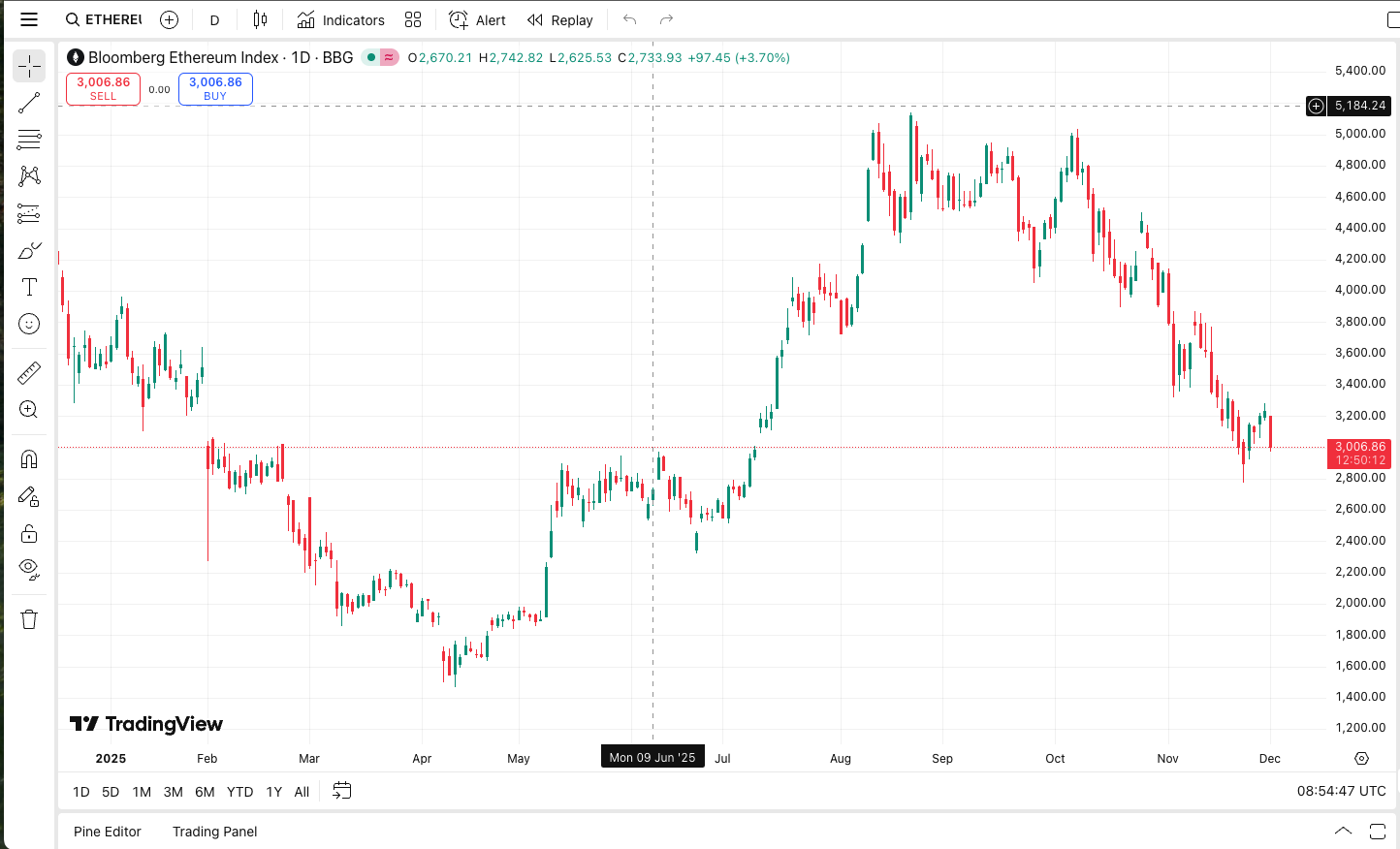
Despite the Price Slide, Ethereum’s Fundamentals Remain Robust
While short-term sentiment looks shaky, Ethereum’s underlying fundamentals remain among the strongest in the global crypto ecosystem.
Major upgrades such as Dencun and Pectra have enhanced network efficiency, reduced gas fees, and fortified Layer-2 adoption. Meanwhile, the deflationary component introduced by EIP-1559 continues to burn ETH as network activity grows.
Ethereum remains the primary settlement layer for Web3, powering:
-
multi-billion-dollar DeFi applications,
-
NFT trading platforms,
-
DAO governance frameworks,
-
RWA tokenization initiatives,
-
prominent L2 ecosystems including Base, Optimism, Arbitrum, and zkSync.
“Every market correction over the past years has shown that long-term holders use dips to accumulate ETH,” one DeFi analyst told Cointelegraph.
Is Ethereum Quietly Entering an Accumulation Phase?
Institutional interest appears to be rising as analysts label the current price region a “prime accumulation zone.”
Key reasons include:
-
ETH’s unmatched liquidity profile,
-
consistent yields from staking,
-
surging activity across Layer-2 networks,
-
a valuation widely seen as attractive relative to Ethereum’s long-term outlook.
Despite the volatility, staking participation remains strong — a signal that long-term conviction in the network hasn’t diminished.
Risks Remain: Macro Pressure and L1 Competition
However, not all observers agree the worst is over.
Ethereum still faces external pressures:
-
Bitcoin-driven market volatility,
-
competition from newer, faster L1 blockchains,
-
a temporary decline in DeFi volume,
-
regulatory uncertainty across major jurisdictions.
Should these conditions persist, analysts warn that ETH could see another leg down before stabilizing.
Potential Catalysts Ahead: L2 Expansion, RWA Adoption, and 2026 Upgrades
Several developments could determine Ethereum’s direction in the coming months:
🔹 1. Layer-2 Activity Surge
L2 networks continue onboarding users and liquidity, increasing ETH demand for gas and settlement.
🔹 2. Real-World Asset (RWA) Momentum
Ethereum remains the leading infrastructure for tokenization of commodities, energy assets, and financial instruments.
🔹 3. 2026 Roadmap Announcements
Upcoming scalability and modularity upgrades have the potential to reshape network performance and valuation.
Conclusion
With ETH trading near multi-month lows, the asset now sits at a key inflection point between bearish momentum and long-term accumulation opportunity.
Yet, Ethereum’s on-chain resilience, expanding Layer-2 ecosystem, and institutional integrations suggest the network’s strategic position remains strong.
ETH may be falling today — but the broader architecture of Web3 indicates the downturn may be setting the stage for Ethereum’s next major cycle.




Leave a reply


The Rubik theme is the best Premium WordPress Themes that perfect for news, magazine, personal blog, etc. It’s never been easier to build a standout website.

The Rubik theme is the best Premium WordPress Themes that perfect for news, magazine, personal blog, etc. It’s never been easier to build a standout website.


The Rubik theme is the best Premium WordPress Themes that perfect for news, magazine, personal blog, etc.


